Catamaran M/C Galapagos
Journey III
Itineraries -
Rates
- Deck Plans
Discover
a world of evolutionary enchantment, amid volcanic islands with unique
species of wildlife on board the First Class Catamaran Galapagos
Journey III. 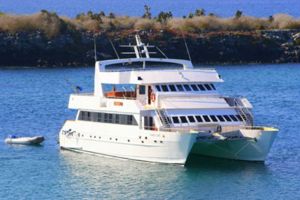 The
vision for this catamaran is to introduce a new level of comfort and
elegance to Galapagos trips. The Galapagos
Journey III offers lots of space and comfort for naturalist cruises.
The combination of stability, grace and speed make this catamaran a
perfect partner for a Galapagos discovery adventure. The Galapagos
Journey III has six cabins with lower twin beds, and two cabins
with one lower double bed. All cabins are exterior and located on the
main deck with outside views, private bathroom,
hot water and individual climate control. The
vision for this catamaran is to introduce a new level of comfort and
elegance to Galapagos trips. The Galapagos
Journey III offers lots of space and comfort for naturalist cruises.
The combination of stability, grace and speed make this catamaran a
perfect partner for a Galapagos discovery adventure. The Galapagos
Journey III has six cabins with lower twin beds, and two cabins
with one lower double bed. All cabins are exterior and located on the
main deck with outside views, private bathroom,
hot water and individual climate control.
The
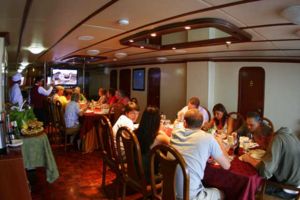
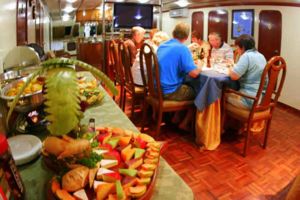
social areas include a comfortable dining room with a TV/DVD and stereo
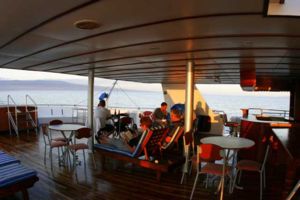
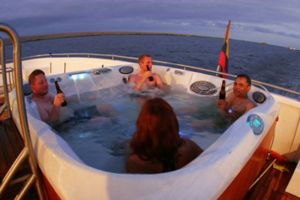
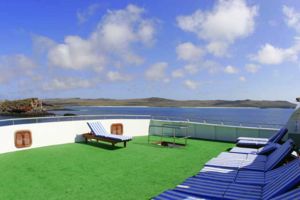
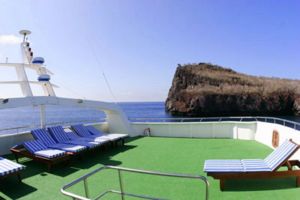
system, inside/outside bars, and a Jacuzzi. The spacious sundeck with
reclining chairs offers a great view of the islands' landscapes.
The
Galapagos Journey III
has a full crew including a Naturalist Guide Level II/III, who has been
trained and licensed by the Galapagos National Park Service.
There
are several advantages of cruising on board a catamaran versus a monohaul
yacht, to mention a few:
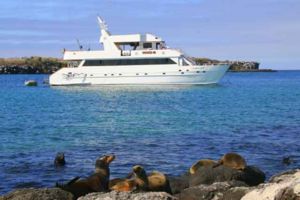 Smoother
Ride: Almost any multihull will offer you a smoother ride in
rough water due to the dual hull design and the construction's parachute
effect as the boat crosscuts the waves. Air trapped between the hulls
cushions the impact of re-entry. As the catamaran does not land on the
hull's centerline, like a monohull would, the effects of the impact
are spread over a wider area. Smoother
Ride: Almost any multihull will offer you a smoother ride in
rough water due to the dual hull design and the construction's parachute
effect as the boat crosscuts the waves. Air trapped between the hulls
cushions the impact of re-entry. As the catamaran does not land on the
hull's centerline, like a monohull would, the effects of the impact
are spread over a wider area.
Stability: Load levels on a catamaran
can be up to 20% greater than a similar size monohull. Catamarans are
incrementally more stable as they do not pivot on the centerline. The
footprint is wider, helping to negate the effects of rolling seas.
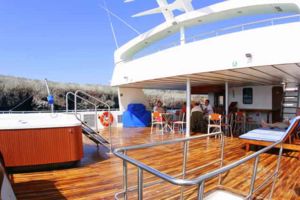
More deck space: A catamaran is
wider than a monohaul yacht offering additional deck space and sunbathing
areas.
Environment friendly: All power
catamarans have less hull resistance in the water, resulting in greater
fuel efficiency (comparatively it takes less horsepower and fuel to
accomplish optimal performance in a power catamaran than in a power
monohull).
Access to remote areas: The catamaran's
shallow draft design allows access to waterways that most conventional
hulls cannot navigate.
|
|
| 2009 |
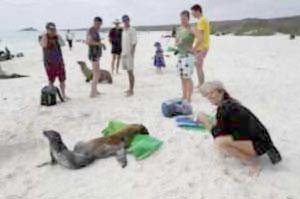
Meet the local residents on a shore excursion
|
| Motor
Catamaran |
|
First Class |
| Fiberglass |
| 90.50
ft / 27.60 m |
| 36.08
ft / 11 m |
| Wooden
flooring |
| Teakwood
flooring |
|
3000 gallons plus water maker with capacity of 1000 gallons per
day |
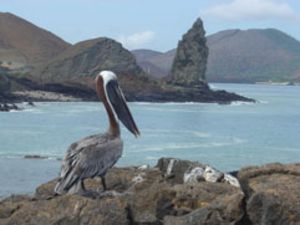
Pelican with Pinnacle Rock in the
Background
|
|
2000 gallons |
| 12
knots |
| 2
x John Deere IMO @ 300 HP each |
| Electric
System: 2 x 50 kw generators (IMO) (110v and 220v AC) |
|
16 passengers in six twin bed cabins and two double bed cabins
on the main decks
|
|
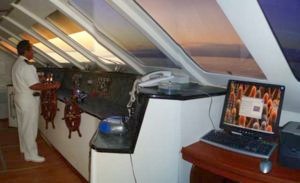
Navigation & Safety Equipment:
One 48 miles Radar; Echosounder; GPS; One VHF radio; Epirb;
Magnetic compass; Two rigid life rafts for 15 passengers eah;
30 SOLAS life jackets; fire & smoke detectors; complete
fire system; Two Zodiac rafts for 10 persons each. Safety equipment
complies with international Coast Guard regulations.
|
|
Crew: 7+ 1 Naturalist Bilingual
Guide III
Snorkeling Equipment
Dining Room
Library
Lounge
Bar
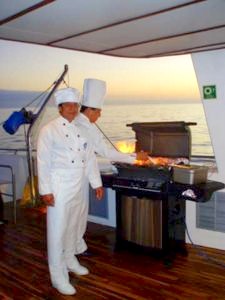
Bar-B-Que
Hot Tub
|

|